Category Archives: exercise

Out the Door

I had a big website project at work that was hanging over my head. My boss wanted to redo our website, specifically the homepage and I was totally up for the challenge. After a few weeks we had the big changes implemented and were moving on to some of the smaller details that weren’t essential to the project, at least as far as I was concerned. I started to feel pressure from my boss because now the project was getting close to going over budget. After implementing a significant round of edits on a Wednesday, I decided that on Friday we were going to launch.

Most people know I’m a converted Apple-guy. As I’ve studied Apple, I’ve been fascinated about the narrative that other business people adopt from the narrative of Steve Jobs. The most common quote from the late Steve Jobs is “real artists ship.” Sadly I am not an artist. Could this quote still apply to me?

Real Artists Ship

I stumbled on this quote reading various business and leadership writings. Many of the writers, in fact, are artists themselves. But I began to see that “artist” could be painted with a broader brush. I have learned that I am an artist. I create things. I edit things. I publish words. I do more than just consume. I am an artist and so if Jobs was right, I need to ship. I need to get things out the door. This means I need to pay attention to how much I consume vs. how much I create. At some point, consumption needs to lead to creation, and my web project for work had plenty of consumption and plenty of creation. But until that Friday when I launched, it really didn’t matter because no one saw it. Hitting publish, shipping my project was when could call it art.

I was reminded of this principle today reading this article by John Muldoon on Medium. It’s a fascinating idea to constantly be aware of your consumption and your creation. This topic also took me to the topic of exercise training. It’s been a long winter, it’s been tough if not impossible to train outdoors. I’ve planned a lot of training for the next couple months. But planning doesn’t do anything for me until I ship it, until I put it into the world and start executing.

Consumption is fun and it certainly has a place for the artist, the business person, the athlete. But growth happens when we execute what we’ve consumed and put it all into practice. Are you consuming more than creating? Do you need to hit “publish” and get some things out into the world? Do you need to start executing?

YMCA Beginner 5K

I started teaching some classes at the YMCA Dane county this spring and I’m excited to announce that I’ll be overseeing the Beginner 5K program at both the east and the west branches. This is a great project for me since I can put the program together with ease and it gives me another great opportunity to coach new athletes. When I was teaching at Harbor Athletic Club, I had a sports conditioning class that went so well that the group continued to meet without me for years after I left that club.

First 5K YMCA

Community is a big part of being successful with your health. I think people crave community and challenge. That’s why the sports conditioning class went so well. And that’s why the 5K class will go so well, too. The beginner 5K class has an additional advantage in that we have a clear goal to work towards. Running a 5K race for the first time will add significant motivation for this group.

As I continue to develop my business, my expertise and my passion for helping people pursuit their health, I’m enjoying the story it’s creating. In the near future I’ll be incorporating other people’s stories, also. Community with a group of runners or a group of athletes in a class is fantastic. But being the digital guy that I am makes me want to develop an online community also. How cool would it be to have a group sharing your fitness story. You challenge them, they challenge you. We all learn and share this journey together! I believe in the power of that. Digital will never replace in person. But it can be a great extension.

I’m always here if you want advice, coaching, or accountability. As I finalize my race schedule for the year, I’d love to hear what you’re up to and if you’ll join me on the course in the near future.

Happy training!

Published Goals Require Execution

I love to execute. I love to jump into something where I know how it works, I know what’s going to happen, I see it through and get the results I expected. I love to execute. But what about when I’m executing something new? What about executing a goal I’ve had for a few years and I’ve failed just as long? Execution on tasks like this is a different bird. Execution is uncertain. If I’m honest, execution doesn’t even get a fair shot.

So what needs to change? I’ve published my goals for 2014 and I know they are important. They will get me where I want to go. They not only benefit me, they benefit my family. As it sits right now, I’m motivated to make these goals a reality. The reality, though, is that some of these goals are pretty big. Big enough that I failed in the past. I don’t want that to happen again. What do I do differently? execute

Instead of the mountain of a goal in front of me, I need to think about President Jed Bartlett. What? You’ve never heard of him? He’s the main character from the West Wing, a show that enjoyed seven seasons of Emmy award-winning honors and a cult following. President Bartlett was famous for saying, “What’s next?” He had big decisions in front of him, he had big meetings to conduct, big conversations to navigate. But he understood that the fundamental question to ask when big things need to happen is this: what’s next?

This week at church Matt Metzger was talking about living our lives in such a way that we pursue rules for Godly living. This is not a religious post, though. It’s a post about taking steps. Watch this video from 32:55-36:22.

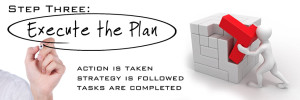
Step one of this blog series was to identify the big goals for the year. Step two is to understand that we reach these goals by executing a number of small steps. What are those steps? I can’t launch my wellness program until I survey the employees to determine their interests. I can’t compete in an olympic triathlon until I train for a certain number of days in the pool, on the bike, and in my running shoes. Every project, every goal has a next step. Not a finished product, a fast track. But a next action step (as David Allen would call it) to move closer to the end game.

It’s a big task, but this week I’ve drafted every project (all the big ones, most of the small) and figured out the next action step on each project. This helps focus our daily efforts which in turn helps us conceptualize our place in the bigger picture of accomplishing these goals, finishing these projects.

As Jim Collins says, great work requires great discipline. This week I’m finishing a disciplined process to convert my big goals into manageable next action steps.

Published Goals for 2014

Goals have gotten a bad reputation. That’s why I like drafting them early in the year and publishing them in the next couple weeks, so we avoid the emotional “conquer the world, do a 180-in-life” kind of commitment. It’s a negative thought to begin this blog post, so let’s get away from that. Let me paraphrase my favorite quote about goals: If you aim at nothing, you are sure to hit it every time. If we do not have clear goals, what can we really expect in 2014? On the other hand, if we plan now, execute all year, how will we fill in the middle of December?

I argue that well-crafted goals, a disciplined routine of execution, and a support staff or inner circle will guarantee 2014 to be the most productive year ever. Big statement, I know. The reason I can make this claim is because very few people follow through with their resolutions and goals. That’s just a fact. Many will read this and put it away, move on to the next Facebook update. Some will participate in the comment section, some will participate alone at their desk. Cool! I’ve done this for quite a few years, I’m ready to take it to the next level. How about you?

(The following goals are in no order of importance.) 2014 Goals Hans Schiefelbein

Wellness program shipped

I will have an functional wellness program for small businesses by March 1. I will done the research, I’ve done the homework, I’ve even worked out some of the kinks with small businesses already. But I’m working towards literally publishing a manual for how to implement a wellness program for small business. I also have a goal in the number of companies I want to work with this year, but I’ll keep that goal internal. Here’s the thing – March 1 is on the calendar because it aligns with a current client and relationship that’s already in place. It will evolve throughout the year and with the subsequent clients, so there’s lots of work after the third month of the year. But the goal is March 1, wellness program.

Exercise is Medicine

I will double the number of doctors I work with for exercise prescription. I think (again) it’s wise to keep numbers to myself right now. Trust me, there’s an inner circle that’s well aware of my numbers goal, and failing to reach those numbers – I take that very seriously.

Correspondance project

I was talking with Katie the other day about when email came into my life. Do you remember your moments? I had an email in high school, I think I was the only one. But when I got to college, it was required. It immediately made communications (basic letter writing) simple. Painfully simple. I always new in middle and high school that I should write more letters. I loved in English class when Mrs. Curtis made us have pen pals with 4th grade students (mine was Katie Ruffel). But in reality, I never made writing a priority. Now with email – it was easy, it was fast, and with pictures it was fun. I want to bring that back. I want to write people more often. I’ll go public with this goal. My goal is to write one person a personal email (or FB message) each week. Relationships are important (more about this coming later in this post). This correspondence project will force me to slow down and improve the quality of my relationships dramatically. I’m especially excited about this goal.

ETB2014

My spiritual goal for the year is to finish Eat This Book. This is the third (!!) time attempting this goal. I’ve failed in the past and I’m not giving up. Not much else to say. I think the Bible is an excellent book, certainly worthy of the first 20 minutes of my day. Talk to me around the 4th of July, I hope to be on pace. Then the week of Christmas you can check in again, it should be just finishing up.

Keep Tri-ing

Last year I became a triathlete. This year I want to continue that and take it to the next level. My goal is to compete in an Olympic distance triathlon and also improve my time in the sprint distance.

Summary:  Your mileage may vary. You may have more detail, you may have less. You may have more goals, you may have one. Please consider having at least one goal by the end of the week. You don’t need to conquer the world. You don’t need to do a complete 180 with your life. But let’s set ourselves up to succeed this year in new and exciting ways. Today was about publishing our goals. Later this week we’ll talk about a plan for executing them. I’d love to hear your thoughts in the comments.

Five things I learned in my first triathlon

On July 14th I competed in my first triathlon. I was happy to do my first one in Pewaukee, my hometown. This particular sprint was a 1/4 mile swim, a 14 mile bike, and a 3.1 mile run. For my first competition I am happy with my results and extremely optimistic about where I can take this. Training for this triathlon was something I had never done before and I’ve learned a lot in the last four months.

1. Anything can do a sprint triathlonFord Ironman World Championship  13 October 2007When I began thinking about competing in a triathlon, I was a runner. I knew running would be at the end of a swim and a bike, but I knew I could hold my own. I didn’t have experience with competitive bike, I knew a lot of my leg strength from running would translate to the bike and I’d be ok. But the swim was going to get me. You see I have really bad shoulders. They dislocate easily. Why do I mention this? Because I want to paint a picture of how training makes these competitions possible. Yes, I have extensive running experience under my belt but with proper training, you can get to the finish line of a sprint triathlon with 8-10 weeks of preparation. My competition distances are listed above. It may seem long to you but I guarantee I can get you to the finish line (and have you smiling on the other side!).


2. Community makes it better

In preparation for my triathlon, I talked with a couple friends who I knew had some experience. I talked with Tim Murphy specifically about the bike. I didn’t have more than six days training because I was borrowing a bike. So I asked him his opinion and he gave me some nice pointers. Then closer to the race I had some questions about gear and he was very helpful. I was also chatting a little bit with Deann McIntosh who has over a dozen triathlons under her belt including a half Ironman! She helped me understand the transition area, when to get to the start, and she really put my mind at ease on race day. I became better friends with these two throughout this process. It’s something we have in common now. As I said, I borrowed a bike from Mark Anderson. Not just any bike: the bike he used for Ironman a few years ago! Is that a great friend or what?! I’m so thankful for his generosity (and trust). After reading my blog posts about the triathlon experience, he suggested we compete in a couple next summer. So now I’ll have a training partner! In those same blog posts I mentioned getting in a run with my friend Todd who has two Ironman competitions to his credit. We’ve already talked about getting our old training group back together to do a couple more this fall. This is after four months of training – all by myself. With very little effort I’ve been able to surround myself with wonderful people and that, as you might imagine, is a huge benefit to this type of training. To each his own, but training with people and talking about the whole process has been a very rewarding aspect of triathlon.

3. Competition with self is strong

I’ve had a hard time explaining this one. I’ve competed in over ten half or full marathons. I’ve never entered a race trying to compete with anyone but myself; I’m not even that fast. But I’ve always tried to better my time. So over here in triathlons, I had a new competitive juice flowing through the veins. I was building on what I already had (the run), and I was competing against myself in this multi-sport event. I think that’s what it is – it’s the multiple sports at the same time that makes this such a challenge and so competitive. Maybe it’s this: “anyone can swim, anyone can bike, anyone can run. But can you combine them all together and compete?” When I got done with the competition, they give you the results in five categories: swim, transition 1, bike, transition 2, and run. Five components that beg to be improved. “Boy, if I could get get that bike up to 22mph, I’d be in the top 15!” See where this can lead…?

4. Katie rocks
Y’all know about Christian, right? Our totally awesome 9-week old boy? So add in Sorin and Norah running around too, it’s been busy in the Schiefelbein house. Yet as the race was nearing, Katie kept pushing me out the door to get a quick run or bike in. The week of the race she had me to a dry run so IC could experience a little what all three events would feel like. There’s only so many hours in the day – I’ve been crazy busy since finishing school and working harder around the house with family. Katie is burning the candle at both ends with Christian. And she pushes me out the door. Grateful doesn’t even begin to explain my emotions on this.

Teri Hatcher, Nabil Kazi

5. You may be surprised at the fun you’ll have
When my sister-in-law Amy did her first triathlon, she said her favorite part of the training was the swim. I remember telling her that that won’t be the case with me. Remember my bad shoulders? I was convinced that I would be on a mission to survive the swim; get out of the water without injury and don’t be in last place. Well, after a couple months of a masters swim class, my technique improved by leaps and bounds. The learning was fascinating to experience. Ready for this? It’s currently my favorite part of the triathlon. It’s fun! It’s a challenge. And with the right coaching and motivation, you too will be surprised at how much fun you can have improving on one or more disciplines in triathlon training.

Pewaukee Triathlon: Swim, Bike, Run

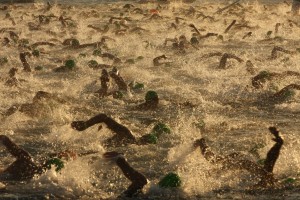
I’m out of the water after my warm-up swim, the water is perfect, and I’m mingling with the other athletes. The swim doesn’t look too bad. They have two large triangle markers in the water about 150 yards out, each about 150 apart. So you swim out, take a right, swim across, take another right, and swim into shore. I’m not really nervous about the swim. I’m thinking about saving my legs for the bike. So that means arm, lots of arms. It’s crazy to be standing on your hometown beach. I never came to the beach as a kid – I was always at the park. But we’re right smack in the middle of downtown Pewaukee. And here I am about to compete in a triathlon. Off to the right they begin the National Anthem. I wish I knew who was singing because it was amazing. As an athlete I’ve always held that moment very sacred: standing at attention, hands behind my back, the start of a great sporting event. A couple hops at the end and we were off to the tunnel. They had all the athletes get organized according to swim cap which was your age group. I was lime green. Kind of hard to gear up for competition wearing lime green.

Within a few moments I was at the front of the line, side by side with another guy. You get to the front and they say “Go,” and we’re off. It was a strange start because it’s walk walk walk, swim! I hit my watch and hit the water. Just as planned, I started off smooth and slow to make sure my shoulders were feeling good. I had plenty of space around me. I got into a nice rhythm and then some guy swam up on me so I kicked a little harder, holding my ground. He must have veered and that was the last distraction I had. I got to the first buoy in 3:37 (yes, I looked at my watch). I was a little behind pace, but as I picked it up, I also make that right hand turn and now I’m breathing on my right side and looking right at the sun each time. Kind of embarrassed to say I didn’t see that coming. Not a big deal. I made it to the next buoy by 5:45, so that felt good. But again, a right hand turn meant now as I spot my course when I look straight ahead, I’m looking right into the sun again. This time it was worse because I was really looking for direction. I was forced to swim towards the sound system on shore. I know I wasn’t swimming as straight as I would’ve liked, and I broke stroke more times than I care to admit in an effort to track my route. All that to say I got out of the water in 9:56, almost 2 minutes longer than I thought it would take.

Putting those feet down and running to shore was a rush. Googles came off with the swim cap in one pull and we were off to transition. There were lots of stones on the run but I made it to my bike as quick as possible. This was my first checkpoint to gather my thoughts and regroup. I threw my shirt on which was tougher than I expected with my wet body. I sat down and got my socks on making sure no stones stuck to my feet – that would be bad on the bike and the run. My Gu packet was already open so I ate that and slammed some water. I skipped the banana and slipped the shoes on. Helmet and glasses, bike off the rack and I was running to Bike Out. They were yelling for us to not get on until we were passed a line, I crossed, jumped on and I was off. Forty yards later so was my water bottle. I had purchased a new straw and accessories for the aero water bottle attached to the front of the bike. One rubber band must have slipped off and the bottle went flying. I had another bottle on the frame and so I had a decision to make. I knew I’d only drink maybe four times on the bike, so I elected to keep going, hoping it would be there when the race was done (it was). Biking out of town was a lot of fun. I’ve watched a lot of Ironman competitions where the crowd is gathered at the swim, they hit the bike and they’re gone. Turning right onto Prospect my legs felt great but it’s a long slow uphill. I picked out bib #454 in front of me and tried to keep pace with him. Classic mistake – not necessarily in this situation because I held my own, but typically it isn’t a good idea to pace off someone who you have no clue what their fitness level is. He could be biking stronger than me, but in this case I was off to a good start. I certainly passed my share of competitors. I settled into the aerobars felt great. For the first six miles I would pass a couple guys but then one or two guys would just blow past me. It’s kind of a kick in the balls – no other way to say it. Some of these guys can just hammer the bike. And I knew this was going to be the case. Biking is by far my least experienced leg of the race. I simply don’t have bike legs yet. But I will. We got out of Pewaukee and were on Gulf Road parallel to 94. I just wish I knew how to pace myself more on the bike. I certainly was a little more conservative than I needed to be but I wasn’t about to bonk on the run. Reaching the halfway point of the route, the hills begin to get bigger. Nothing was too challenging, but I know my lack of training on hills was pounding me into submission at this point. And again, plenty of biker wet powering past me. Boy, they can hammer! It gives me so much to work on, it was truly very motivational. I had really good perspective and expectations for this race. What goes up must come down, so we had some nice rides upwards to 35mph which were a lot of fun. There were a couple cat and mouse games with some riders, my bike was able to track them down at certain section and vice versa. And then just like that we were turning back onto Wisconsin for the home stretch. Getting off the bike I tried running in my shoes which have the clips and I really didn’t like it. I was very worried I’d slip and twist an ankle so I pulled over and took my shoes off. I’m not sure I’d do that again because it was a project to run with the bike and shoes. Again, the tunnel had plenty of stones and now the volunteers were yelling at us that the ground was wet and slippery also. I made it to my spot, racked the bike, helmet off and shoes on. I threw a Gu into my back pocket and was off.

Those first few hundred meters were tough. Slow strides, things don’t seem right for an experience runner like myself. And everything is so slow! I was staying pace with one guy who looked pretty strong, but there were two other guys who looked like I should be blowing them out of the water. Wasn’t happening. Every step, so slow. Again, with more brick training (doing a bike ride followed immediately with a run) I’ll master this transition. The first mile I got my legs under me which started to feel better, but then mile two is a long, slow uphill. It peaks at the top of School Street, the campus of the Pewaukee School District. This was a pretty cool moment running around the streets where I spent 13 years of my childhood education. A lot of it looks different, but I guess I’m pretty different too. Lots of pride in that city, lots of memories. Feels great to be back. After weaving down and back a couple roads up there, I ran past the football field and old practice field. It’s on this campus where I grew to be an athlete; it was fulfilling to return in competition like this. I made one last turn and remembered my first race as a kid, some kind of trail run through school – hardly anyone did it but it was back in the fields at the time; now new building stand where the race was held, but I remembered that race and again appreciated the journey, the memories.

No one says a thing on the course. Bike 13 miles, run 3.1 miles… nothing. But I was thankful for one guy who spoke up just in front of my old elementary school. He said “exactly one mile left.” My GPS wasn’t working and I knew about how far we had to go but I didn’t know mileage. My split of the run was 17 minutes, so one mile left meant I had been running 8:45 miles. I thought to myself that I can go a lot fast than this for one mile. So at the bottom of the hill I picked it up. That last mile felt great and I ran it in about 7 minutes. I crossed the finish line of my first triathlon in 1:22:38.
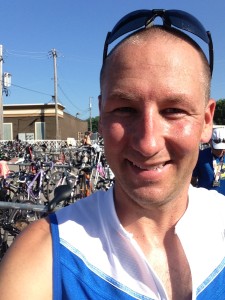
Finished and satisfied

Finished and satisfied

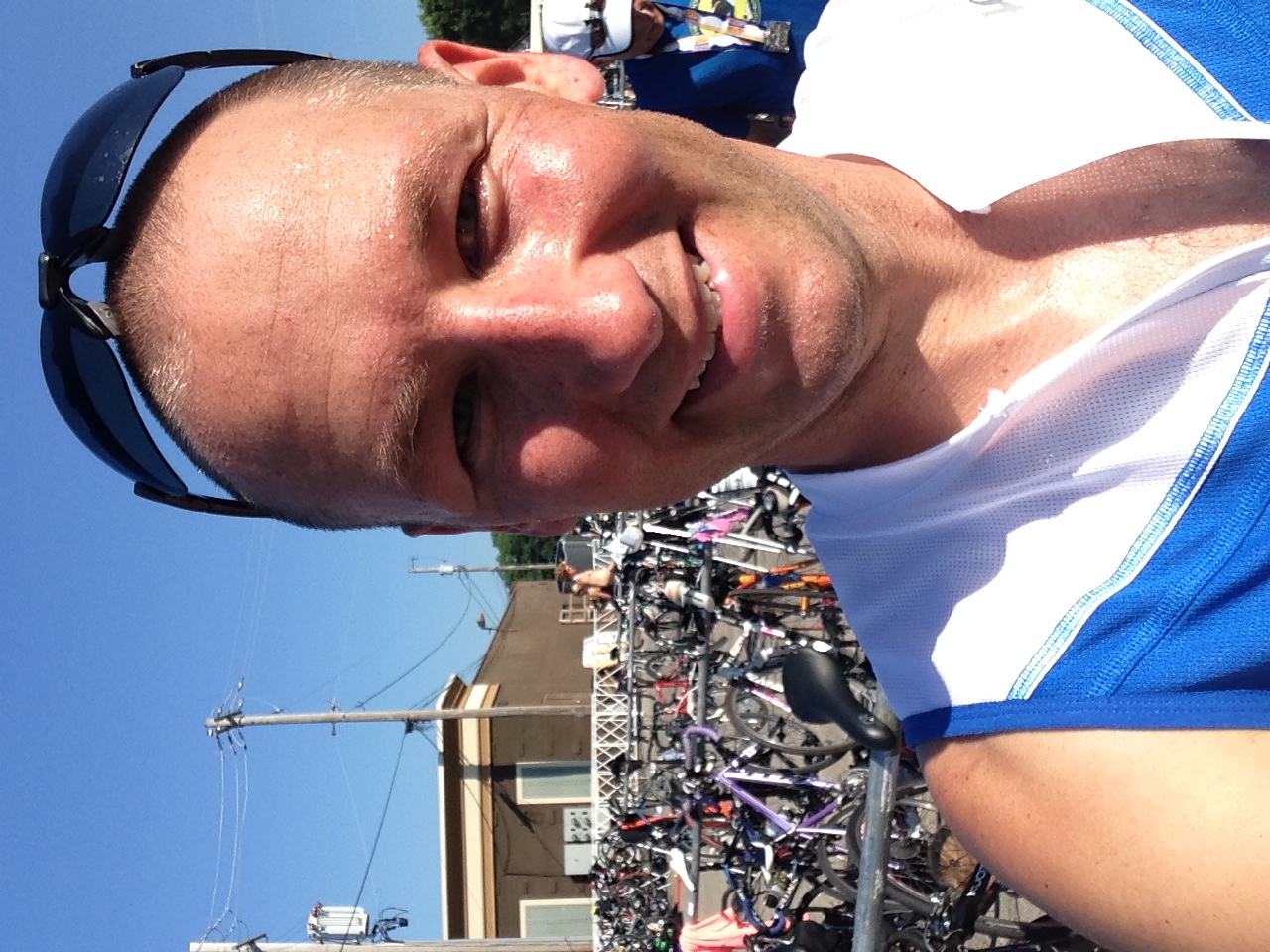
The first words in my mind were “Wow, that felt great.” Then I thought “Where’s the chocolate milk.” They had none. And finally, before I took of my ankle timing chip, before a got a medal around my neck, I was thinking “What’s next?” It’s addicting. I’m hooked. It was a fun race and I can’t wait to do it again. It means lots of training, lots of dedication and preparation from workouts to nutrition to balancing training time and family time. But I’m committed. You’ll see me in Pewaukee next year as long as it fits with other races I know I’ll want to do. And I want to get others involved. Honestly triathlon is very doable. I want to put a team together to train for these next year. There’s so much that can be gained by training for something like this. I want others to join me in this pursuit.

There you have it. It was a fantastic experience. I trained well, I have a lot of work in front of me. And I have a lot of people to thank. First, we had our third child eight weeks ago. Katie is working so hard with Hans Christian and she’s not getting a lot of sleep. But she pushed me out the door a number of times to get a run or a bike ride in. She challenged me to do a mini-tri in preparation for my first competition. I’m so thankful for her encouragement, coaching, and handling of our house as I train. Also, it should be noted I don’t own a bike. My friend Mark Anderson let me borrow his bike (which he used for Ironman!) and I literally couldn’t have done this without him. I started competitive swimming in March and thanks to Katie at the McFarland high school pool, I’m starting to figure it out. She’s a great coach. My friend Todd has a couple Ironmans under his belt and on our last training run he gave me some pointers and our friendship has started to fuel some ideas for future races. Tim Murphy did the Olympic distance this year, and knowing that I hit him up with some questions before the race since he had done the sprint distance the year before. Deann McIntosh made sure I was at transition early enough and she put me at ease with my transition gear set-up. It’s been fun getting to know her a little more the last few weeks. I didn’t have to pay for a hotel in my hometown thanks to Josh Goodman – it was great catching up with one of my oldest friends. Do you see how this works? It’s a team thing! I’m hooked. What say you?
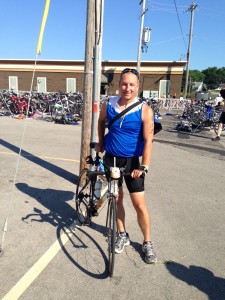
 

First tri in the books.  Many more to come!

First tri in the books. Many more to come!

First Triathlon Competition: Pewaukee Sprint

I thought marathons started early! Sunday I had three alarms set for 4:00, 4:10, and 4:15… AM! (The first one worked.) My triathlon advisor, Deann McIntosh, told me she’d be getting to the transition between 4:30 and 4:45. Being my first triathlon, I wasn’t going to argue. I was determined to get to the transition by 4:45. I was up and out of the house by 4:25. I ate a bagel with peanut butter on the drive to the finish line where I was parked my car. I was at transition by 4:45. What a cool bike ride with all your gear. It’s only a half mile, easy ride, completely dark. The guy in front of me had a headlamp. He didn’t need it, but just having it meant we were up early! And it meant he was prepared. That was my recurring thought all morning: “am I prepared?”

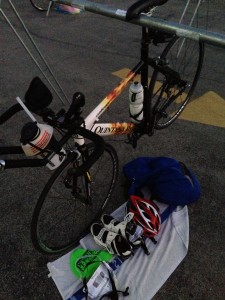
bike set up tri

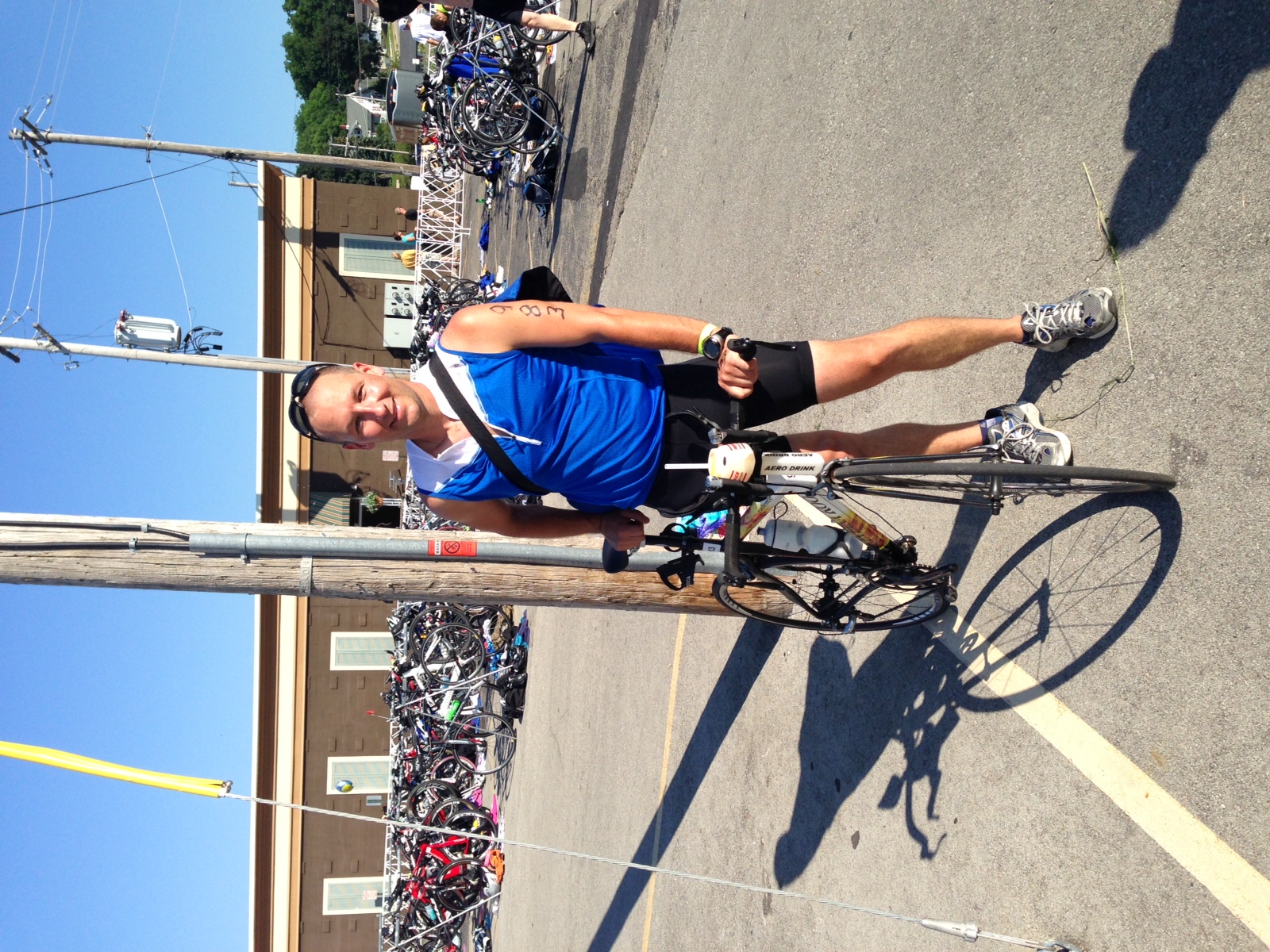
My yellow wristband from the expo registration allowed me into transition. It’s a pretty secure area because everyone stores their bikes there, and there is a lot of money in those bikes! I found my spot which was kind of cool. Again the early start and the personal spot is so different from marathon races. I put my towel down and got everything set up by 5:10. When I say “got everything set up,” I mean I set it up in about 30 seconds and re-checked it about 15 more times. “Am I prepared?” It’s pretty simple. You wear your tri shorts, goggles and swim cap. Get out of the water and put on shirt, socks, shoes, bike helmet and glasses. Get off the bike and put on running shoes. That’s it. But on my first tri I couldn’t stop checking my gear.

I went to get body marking – no. 983. They put it on both arms, left hand, and then age and “S” (for sprint distance) on your right calf. I got back to my bike and had another half of a bagel and a banana. I figured that was plenty of fuel other than the planned Gu packet before the bike and maybe right before the run. But I’ve never fueled for a triathlon, so again I was asking myself if I was prepared? This is where my previous experience with running kicked in. I was figuring on being out there from 70-90 minutes. I takes me longer to do a half marathon, and I’ve fueled for that plenty of times. So yes, I was prepared. Just to make sure everything was set, I called over Deann to check my gear. She made one adjustment and put me at ease. She asked if I was nervous and I said, no – just excited.


It feels good to compete. It also feels good to try something new. I’ve been competing in half and full marathons for over six years, but this new sport is fueling those competitive juices. I’ve been learning how to swim since February, and that training has really paid off. My weakest part of the triathlon is the bike. It utilizes different muscles and I just haven’t put in the time. The run would be a breeze. I could run 3.1 miles backwards if I had to. The only issue was it would come on the back side of a swim and bike course which I’ve never done before. Katie challenged me to do one trial run, a mini-triathlon in preparation for this, so I had a decent idea what it would feel like.

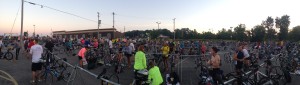
transition area Pewaukee tri

Back in transition I looked things over one last (16th) time, went to the restroom, and did a little warm-up run. Transition closes at 6:00 and the race starts at 6:15. I got in the water to swim about 100m. The water was amazing. My arms and legs felt great. 50m out, I turned back to the shore and got really jacked up seeing all the fellow athletes ready to compete. I swam back to shore, walked out of the water and was bursting inside with excitement. Yes, I was prepared – and now I’m ready to go!

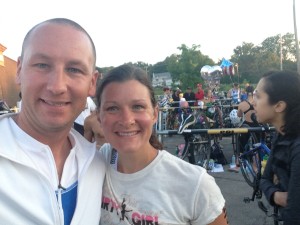
Hans Deann Pewaukee tri

Tomorrow I’ll take you through my entire first triathlon. Thanks for reading.

My First Triathlon

I am so excited to compete in my first triathlon this Sunday. I’m doing the Pewaukee sprint. It’s a 1/4 mile swim, 14 mile bike, and 3.1 mile run. I’ve worked hard training for the swim but the open water aspect will be the challenge. The run will be no problem. The bike is where I lack experience.

I’m very thankful Katie has allowed me to get out and train for this while we are getting settled at home with Christian and his sleeping struggles. I’m also very excited about where this trial on thing will take me. I’m not afraid to claim that the road to Ironman starts here. It’s a long road, but I am eager for the challenge.

If you’re in the Pewaukee area it would be great to see you on the course.

Bridging Grad school to the real world

Graduate school is done. I’ve poured over two years into earning a masters degree in kinesiology and I am very proud of the work I produced, the friendships I made, and the growth I experienced.

As I begin to process my time as a grad student and how it will transition my career, I keep asking myself what I learned. The coursework wasn’t as straight forward as I was expecting. But the two years taught me a ton about myself and the process of learning and working. I’m a naturally reflective person and so when I say “learning and working” I mean “how will I take what I’ve learned and apply it to a career?” This begins with a mental framework.

20130524-153643.jpg

I keep visualizing a bridge. Graduate school was full of scientific papers and grant proposals. A bunch of the material was stuff I will never look at again. And all along the way I kept asking myself, “how do I apply this to make people healthier?” I learned from and worked along side brilliant professors, researchers, and other graduate students. Most of them are spending their careers in research, conducting experiments and writing in scientific journals. I don’t have a passion for that. But each semester I was coming across literature and data that was begging me to be applied to the clinical world. I often used the term clinical because we worked with so many doctors and it was easy to compare the research world with the clinical hospitals. This is where the bridge kept showing up in my head.

The scientific community is not perfect. They are not all-knowing. When you get into many of the topics we learn that we don’t know as much as we think we do. Or that there are conflicting reports about an issue. Nonetheless, there are brilliant papers and concepts in the literature that need to see the light of day. They need me to get them into the real world so that they can help make people healthier. And who knows, maybe my applications will lead to follow-up studies so we can make our adjustments and make the field even better.

The next step isn’t clear to me. But I am confident that I’m about to create a bridge to connect the scientific community with the real world.

Celebrating Success

Last week I wrote about a failure in my training. I had a swim workout that was horrible and kind of caught me off guard. I was surprised and then I was frustrated. When I walked away for a few hours, I was able to process what happened and knew it was all part of the learning process. But I still didn’t have any first hand evidence that learning was going to take place, I had no success under my belt.

Yesterday I found that success. I had another swim class and things started to click again. It wasn’t easy. In fact our first 400 meters I thought my legs were going to fall off. And that was our first 400! After that we did a bunch of pulling technique where you can’t use your legs. Now I was worried about my arms falling off! Welcome to swim practice. Even through all this, I had a very successful workout. At the end our coach told us we had done 2100 meters in under 48 minutes – apparently that’s pretty good.

I have a long way to go as a swimmer. But actually after that workout for the first time our coach called me a swimmer. Kind of cool to reach another level in training.

It is really easy to get caught up in both the successes and failures in training, learning, growing. Getting better is a very cognitive process. And I think it’s critical to celebrate the successes. We need to know when we’ve done well.